
Aerosol products are widely used for everything from personal-care products and household cleaners to industrial sprays and specialized applications. One of the key components that makes an aerosol package work is its propellant.
Propellants create the pressure needed to push a product out of a pressurized container when the valve is activated. Depending on the formulation and application, manufacturers may use a liquefied-gas propellant or a compressed-gas propellant.
The choice of propellant affects how an aerosol sprays, how consistently it performs throughout its use, and how the product must be handled and stored. This guide explains how aerosol propellants work, the main types used today, and how they differ.
Why Are Propellants Used in Aerosol Cans?
An aerosol formulation generally contains two important components:
- The active ingredient or product being dispensed
- A propellant
The aerosol can propellant provides the pressure required to force the product through the valve and nozzle. Without sufficient pressure, an aerosol would eventually lose its ability to dispense the product effectively as the contents are used.
For example, when an aerosol can uses a compressed gas, the pressure in the headspace generally decreases as the product is discharged and the gas expands. This can result in reduced spray performance toward the end of the can’s life.
For information about aluminum aerosol cans, manufacturers can also consider the container material and design alongside the propellant system.
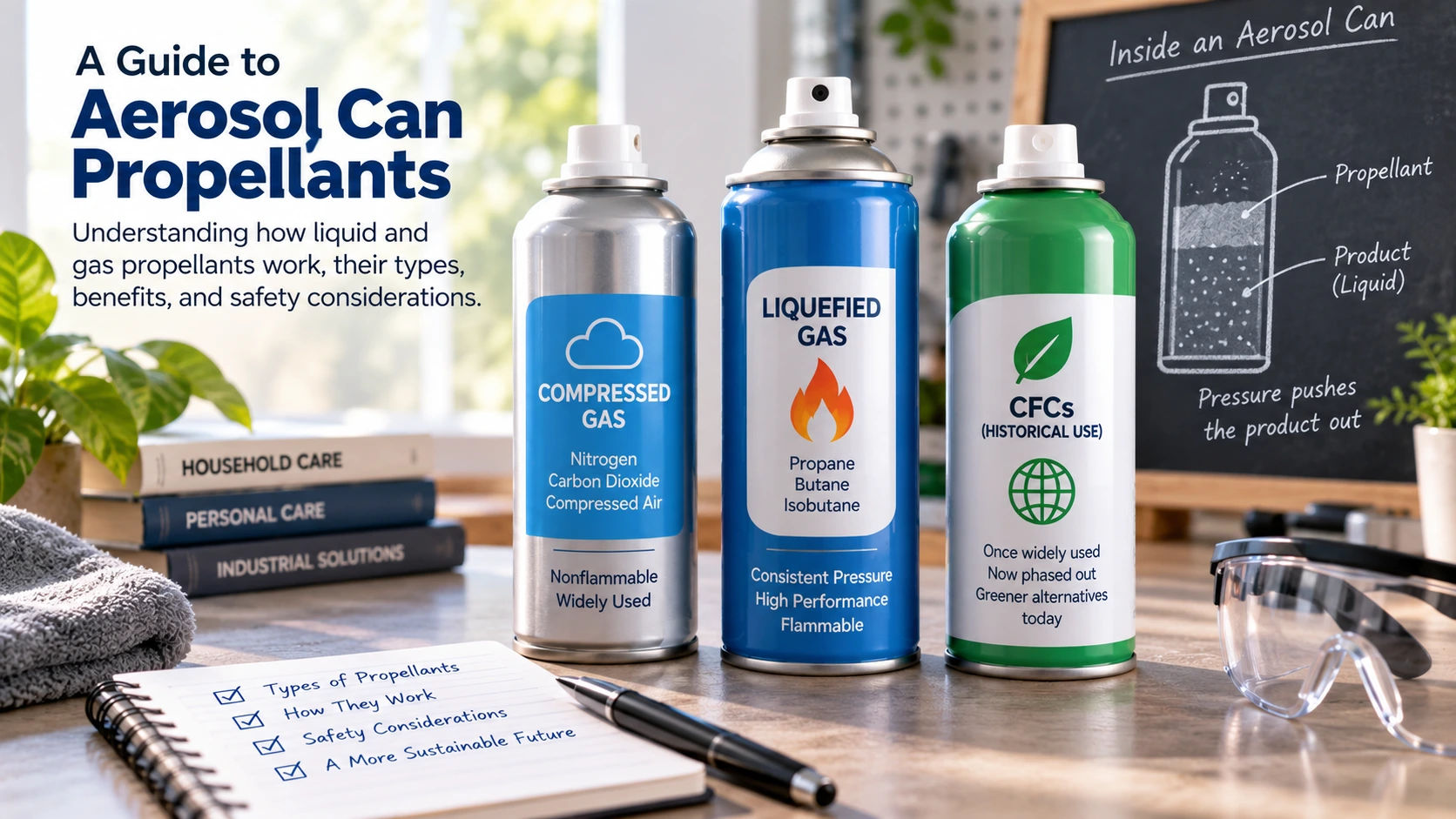
Liquefied-gas propellants work differently. When the product is released, some of the liquid propellant vaporizes and replenishes the gas in the headspace. This allows the container to maintain a relatively consistent pressure while liquid propellant remains available.
As a result, the type of propellant selected can have a significant effect on spray consistency, product delivery, formulation compatibility, and safety.
What Are the Main Types of Aerosol Can Propellants?
Aerosol propellants can be divided into several broad categories. The two major groups discussed here are compressed gases and liquefied gases. Fluorinated propellants have also been used in specific applications, although many older ozone-depleting substances have been phased out or restricted.
Compressed Gas Propellants for Aerosols
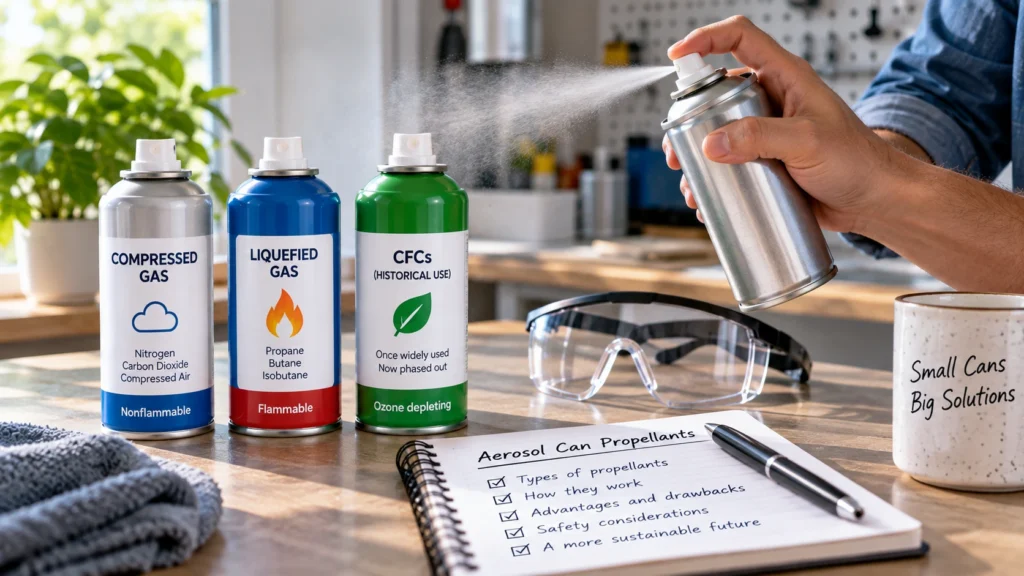
Some aerosol products use compressed gases such as nitrogen, carbon dioxide, nitrous oxide, or compressed air as their propellant. These gases are stored in the container under pressure and provide the force needed to discharge the product.
One advantage of compressed-gas propellants is that gases such as nitrogen and carbon dioxide are nonflammable. They can therefore be useful in applications where a nonflammable propellant is desirable, although the characteristics of the complete aerosol formulation still need to be considered.
The main limitation is pressure loss. Unlike a liquefied-gas propellant, compressed gas does not provide a liquid reservoir that continually vaporizes as the headspace increases. Consequently, the internal pressure generally falls as the product is consumed.
This reduction in pressure can affect the spray pattern and dispensing performance as the can approaches empty.
Liquefied Gas Propellants in Aerosol Cans
Liquefied gases are among the most widely used aerosol propellants. Common examples include:
- Propane
- n-Butane
- Isobutane
These hydrocarbons can be used individually or blended to obtain desired pressure and formulation characteristics.
Inside a pressurized aerosol container, part of the propellant exists as a liquid while another portion exists as vapor. When the product is discharged, the pressure in the headspace begins to fall. Some of the liquid propellant then vaporizes, helping restore the gas pressure.
This mechanism allows liquefied-gas aerosol systems to maintain relatively uniform pressure during much of the product’s useful life.
However, hydrocarbon propellants are flammable. Aerosol products formulated with these propellants therefore require appropriate precautions during manufacturing, transportation, storage, and use.
For that reason, manufacturers must consider factors such as flammability, container design, formulation compatibility, filling processes, and applicable regulations when selecting a hydrocarbon propellant.
Information about an aerosol can manufacturer can be useful when evaluating packaging options for products that require pressurized dispensing.
Chlorofluorocarbon (CFC) Aerosol Propellants
Chlorofluorocarbons, commonly called CFCs, were historically used as aerosol propellants. They offered useful characteristics, including low flammability, but their impact on the stratospheric ozone layer led to international and national restrictions and phaseouts.
In the United States, the use of CFC propellants in most aerosol spray products was phased out beginning in 1978. Regulations also prohibit the sale and distribution of certain aerosol and pressurized products containing CFCs and HCFCs.
Because of these environmental concerns, modern aerosol formulations generally use alternative propellants or dispensing technologies, depending on the application. Alternatives can include hydrocarbons, compressed gases, certain fluorinated compounds, and non-aerosol systems such as mechanical pumps.
Liquid Gas vs. Compressed Gas Propellants
The main difference between these two systems is how they maintain pressure inside the aerosol container.
Liquefied-gas propellants contain both liquid and vapor phases. As the product is dispensed, liquid propellant can vaporize and help maintain pressure.
Compressed-gas propellants are stored as gas in the headspace. As the product is discharged, the gas expands and the internal pressure generally decreases.
This difference can influence spray consistency, discharge characteristics, formulation design, and the amount of product that can be effectively dispensed from the container.
What Should Manufacturers Consider When Choosing a Propellant?
Selecting an aerosol propellant is not simply a matter of choosing the gas that produces the highest pressure. Manufacturers typically need to evaluate several properties, including:
- Flammability
- Vapor pressure
- Compatibility with the formulation
- Solubility
- Product stability
- Container compatibility
- Spray characteristics
- Storage and transportation requirements
- Environmental impact
- Applicable regulations
For example, hydrocarbon propellants can provide useful pressure characteristics but are flammable. Compressed gases can provide a nonflammable option in many applications but may experience a greater pressure decline during use.
The best choice therefore depends on the product, dispensing requirements, formulation, packaging system, and regulatory environment.
Safety Considerations for Aerosol Propellants
Aerosol cans are pressurized containers, so they should always be handled according to the instructions and warnings supplied by the manufacturer.
Particular care is important with aerosols containing flammable hydrocarbon propellants. Such products should be kept away from ignition sources and handled and stored according to their labeling and applicable safety requirements.
Hydrocarbon propellants such as propane, butane, and isobutane are flammable aerosol propellants. Manufacturers also need appropriate controls during filling and production when working with flammable propellants.
Bottom Line
Aerosol propellants play an essential role in how pressurized products are dispensed. Liquefied-gas propellants, including propane, butane, and isobutane, can provide relatively consistent pressure because the liquid propellant vaporizes as the product is discharged. Compressed gases, such as nitrogen and carbon dioxide, can also be used but generally experience a pressure decline as the contents are consumed.
Older CFC propellants have largely been phased out because of their contribution to ozone depletion, and regulations continue to shape which propellants can be used for particular aerosol applications.
Understanding the differences between liquid and compressed gas propellants helps manufacturers select an appropriate aerosol packaging system while balancing performance, safety, formulation requirements, and environmental considerations.
Frequently Asked Questions About Aerosol Can Propellants
What is an aerosol can propellant?
An aerosol can propellant is a gas or liquefied gas that creates pressure inside an aerosol container, allowing the product to be pushed through the valve and nozzle.
What gases are commonly used in aerosol cans?
Common propellants include liquefied gases such as propane, n-butane, and isobutane, as well as compressed gases such as nitrogen and carbon dioxide.
What is the difference between compressed gas and liquefied gas?
Compressed gas is stored primarily as a gas and normally loses pressure as the product is discharged. Liquefied gas contains both liquid and vapor phases, allowing some of the liquid propellant to vaporize and help maintain pressure during use.
Are aerosol can propellants flammable?
Some are and some are not. Hydrocarbon propellants such as propane, butane, and isobutane are flammable, while gases such as nitrogen and carbon dioxide are nonflammable.
Are CFC propellants still commonly used?
No. CFC aerosol propellants have been largely phased out because of their ozone-depleting effects, and their use is restricted or prohibited in many applications.
Why does an aerosol can lose pressure?
The behavior depends on the propellant. Compressed-gas systems generally lose pressure as the contents are discharged. Liquefied-gas systems can maintain relatively consistent pressure while liquid propellant remains available because the liquid can vaporize into the headspace.
What should manufacturers consider when selecting an aerosol propellant?
Manufacturers should consider factors such as vapor pressure, flammability, formulation compatibility, product stability, container compatibility, spray performance, environmental considerations, transportation requirements, and applicable regulations.